
Architecture Map
BLOGE is best understood as a layered orchestration system. The core remains embeddable, but the current source tree has grown beyond a small DAG library: it now includes a DSL platform, extension runtimes, durable operations, common operators, and authoring tools.
This page is verified against BLOGE 0.9.8-RC1 source commit cc38fbe5bb79ccc603888e4307cfe566d4674ffc.
Five Layers
| Layer | Primary modules | What it owns |
|---|---|---|
| Execution kernel | bloge-core, bloge-runtime-spi | Graph model, scheduler, operators, context, resilience, saga, timers, work items, graph versioning |
| Language and contracts | bloge-dsl, bloge-dsl-caffeine, bloge-lang, bloge-conformance | DSL parsing, AST, compiler, schema validation, imports, expressions, conformance parity |
| Extension platform | bloge-session-ext, bloge-state-ext, bloge-agent-ext | Provider-owned syntax, semantic compilers, nested operator factories, extension-specific lint |
| Durable operations | bloge-durable, bloge-durable-mybatis, bloge-durable-codec, bloge-event-journal, bloge-spring-web | Checkpoints, leases, recovery, event journal, audit journal, task inbox, archive, ops console |
| Ecosystem and tooling | bloge-spring, bloge-common-operators, bloge-metrics-otel, bloge-lsp, bloge-vscode, bloge-intellij, bloge-maven-plugin, bloge-lint, bloge-test | Framework integration, operator catalog, telemetry, editors, metadata, engine testing |
bloge-verification crosses these layers rather than becoming a sixth runtime layer. It consumes Scenario, Policy, Fixture, DSL, core, durable, and customer Operator inputs to execute the real graph and produce a separate verification result.
Business Verification Path
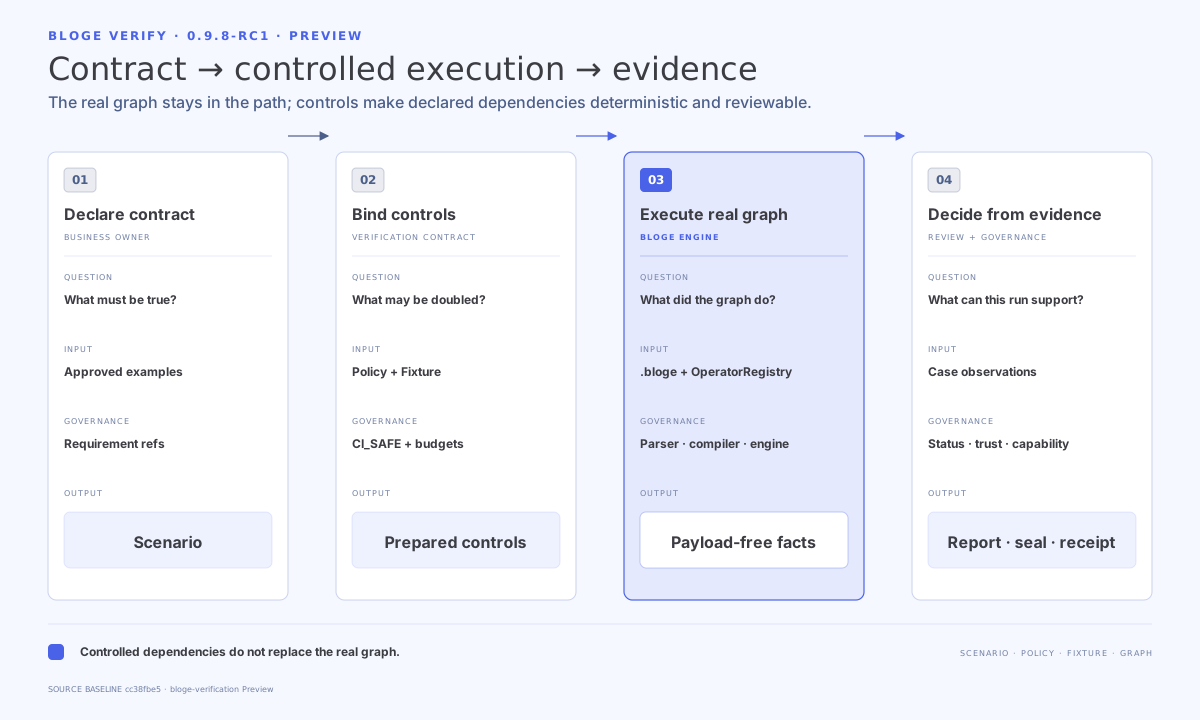
The verification result has three independent projections: execution status, evidence trust, and claim capability. See BLOGE Verify before treating any result as a gate.
Execution Path
The normal runtime path is intentionally compact:
LIVE EXECUTION · APPROVED PATHIndependent reads run together, then the graph joins their outputs.
Watch the payload move left to right: two ready nodes run in parallel before pricing and credit approval.
- Graph input
- customerId=C-104 · productIds=[P-7,P-9]
- Graph result
- orderId=O-2048
Now running: Load customer + Load inventoryapproved = true
DSL and Java authoring converge on the same Graph model. The runtime does not create a second programming model for DSL users.
DSL Compilation Path
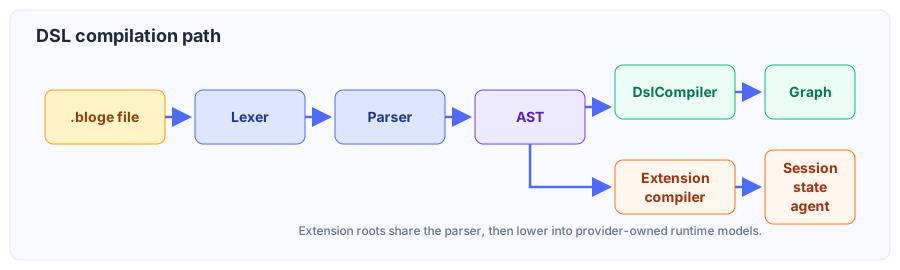
Extensions do not patch the core parser ad hoc. They register provider-owned syntax and compilers through the DSL extension SPI.
Durable Runtime Path
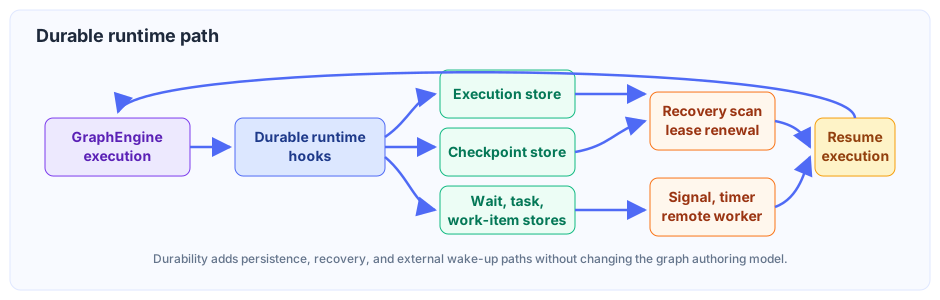
Durability adds persistence, recovery, routing, and operations without changing the basic graph authoring model.
Choosing the Right Model
| Use this | When the workflow is |
|---|---|
| Plain graph | A DAG of business capabilities, API calls, decisions, and transforms |
foreach / loop | Repeated work, polling, pagination, or batch processing |
wait / await | Timer or external-signal suspension inside a graph |
| Session | Multi-round conversational or interaction workflows |
| State machine | Explicit named states and event-driven transitions |
| Agent | LLM reasoning loop with tools, memory, and exit conditions |
| Remote worker | One node must run outside the orchestrator process |
| Dynamic subgraph | A controlled runtime-generated graph should execute as a nested workflow |
Reading Order
- Start with What is BLOGE?.
- Build a small graph in Getting Started.
- Understand runtime semantics in Operator & Graph and Execution Model.
- Learn the language in DSL Overview.
- Add production concerns through Durable Flows, Event Journal & Ops Console, and Observability.
- Add business-owned acceptance paths through BLOGE Verify.